By Tatenda Chitagu
THE Pan African Parliament (PAP) has been dubbed the big brother of all parliamentary institutions on the continent.
The 275 member legislature sits in Midrand, South Africa where Zimbabwe is represented by a delegation led by Chiefs Council president, Senator Chief Fortune Charumbira (the PAP current president). The other members are Stars Mathe (ZANU PF), Pupurai Togarepi (ZANU PF), Tatenda Mavetera (ZANU PF) and Tapiwa Mashakada (MDC-T).
Zimtracker covered one of its sessions a few days ago and below, explains how the continental body operates:
What is PAP?
Also known as the African Parliament, PAP is the continental legislative body of the African Union which held its inaugural session on 18 March 2004 led by its first president, Tanzanian Getrude Mongella. The Parliament exercises oversight, and has advisory and consultative powers. The term of office is five years.
PAP was born out from the 1991 Treaty Establishing the African Economic Community, adopted by AU member states on 3 June 1991 in Abuja (also known as the Abuja Treaty). This treaty established parameters for realizing economic development and integration in Africa and called for the creation of a continental parliament, amongst a set of organs, as tools for the realization of African integration and economic development.
Overall, the goal of PAP is to have full legislative powers and legally binding powers. Currently, it only has consultative, advisory and budgetary oversight powers within the AU.
Composition:
The parliament consist of five members per member state, including at least one women from the delegations. These members, who should reflect political diversity, are selected by their member states and their domestic legislatures.
A parliamentarian’s term corresponds with his or her own national parliament term or any other deliberative organ that elected or seconded them to PAP.
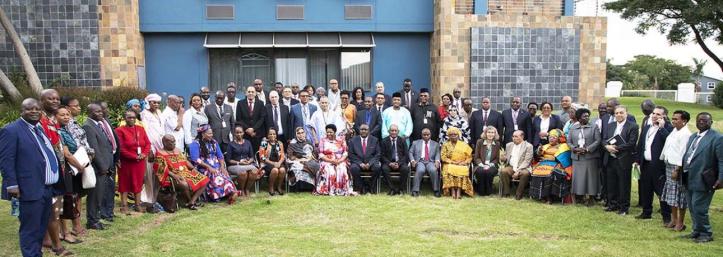
Current members of PAP. President Fortune Charumbira sits at the centre (pic by PAP)
PAP has three sections: the Plenary, the Bureau and the Secretariat.
The Plenary, which is the full assembly of the Parliament, is the main legislative and deliberation section of the Parliament, where representatives meet regularly to discuss issues in Africa and potential solutions. Chaired by the president of the Parliament, it is the main decision-making body and passes resolutions.
The Plenary is made up of permanent committees.
There are 10 Permanent Committees and 1 ad hoc one, whose mandate and functions are set out in the PAP Rules of Procedure. Committees are on Education, Culture, Tourism and Human Resources, Cooperation, International Relations and Conflict Resolution, Gender, Family, Youth and People with Disabilities, Monetary and Financial Affairs, Trade, Customs and Immigration Matters, Health, Labour and Social Affairs, Transport, Industry, Communications, Energy, Science and Technology, Rules, Privileges and Discipline, Justice and Human Rights, Rural Economy, Agriculture, Natural Resources and Environment and Audit and Public Accounts (CAPA).
PAP leadership
The Bureau consists of the leadership that involves the president and four vice presidents, all of whom are elected by delegates in the Plenary.
Zimbabwe Chiefs Council president, Senator Chief Fortune Charumbira is the current president of Pan African Parliament (PAP).
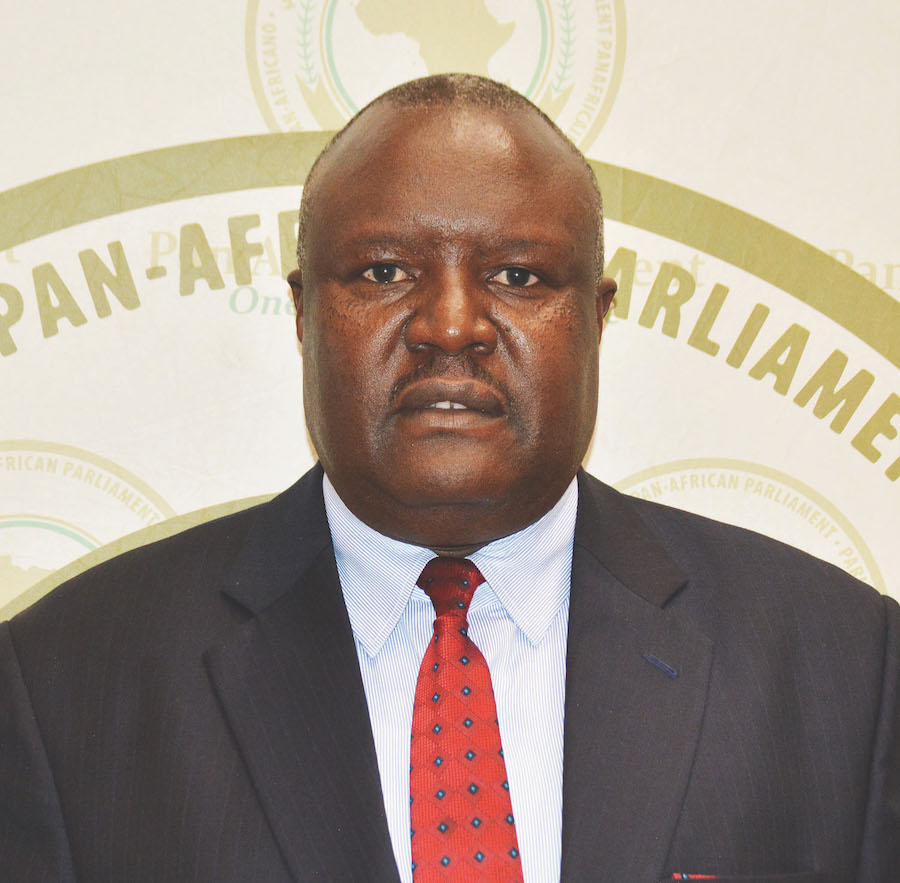
He took over from Roger Nkodo Dang, from the West African State of Cameroon, who had held the post from May 2015 to April 2020.
The first vice president is Hon. Prof. Massouda Mohamed Laghdaf from Mauritania. The second vice president is Dr Ashebiri Gayo from Ethiopia. The third vice president is Lúcia Maria Mendes Gonçalves dos Passos from Cape Verde while the fourth vice president is Francois Ango Ndoutoume from Gabon.
The Bureau is responsible for the management and administration of the affairs and facilities of Parliament and its organs, regulating the procedures relating to the financial, organizational and administrative needs in accordance with Financial Rules of the AU and matters concerning Members and the internal organization of Parliament and its organs. It also determines the draft agenda and the programmes of the sessions of Parliament, plan and structure the Secretariat and lay down regulations for the staff, including their terms and conditions of service.
It also prepares the draft budget and its presentation to the responsible Committee coordinates and harmonizes the functions of Permanent Committees.
The Secretariat is the organisational section of PAP, made up of the Clerk, the Deputy Clerk, and an Acting Deputy Clerk and support staff. It helps in the day-to-day running of the Parliament, including reporting meetings, organising elections and managing staff.
Meetings
The PAP should meet at least twice in ordinary session within a one-year period. Parliamentary sessions can last for up to one month. The PAP can also meet in extraordinary sessions.
The Permanent Committees meet twice a year (March and August) for statutory meetings and can meet more often during parliamentary sessions or for non-statutory meetings when the need arises.
The caucuses meet in ordinary session twice a year during parliamentary sessions.
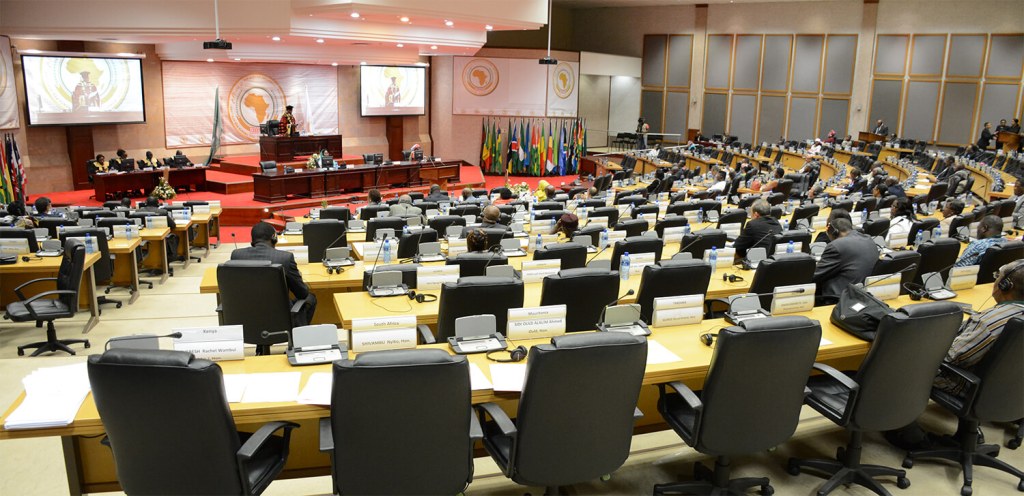
PAP members in session in the chambers (pic by PAP)
Powers of PAP:
The Functions and Powers of the PAP are defined in Article 11 of the Protocol to the Treaty establishing the African Economic Community Relating to the Pan-African Parliament:
a) Examine, discuss or express an opinion on any matter, either on its own initiative or at the request of the Assembly or other policy organs and make any recommendations it may deem fit relating to, inter alia, matters pertaining to respect of human rights, the consolidation of democratic institutions and the culture of democracy, as well as the promotion good governance and the rule of law.
b) Discuss its budget and the budget of the Community and make recommendations thereon prior to its approval by the Assembly of the African Union.
c) Work towards the harmonization or co-ordination of the laws of the Member State.
d) Make recommendations aimed at contributing to the attainment of the objectives of the OAU/AEC and draw attention to the challenges facing the integration process in Africa as well as the strategies for dealing with them.
e) Promote the programmes and objectives of the OAU/AEC, in the constituencies of the Member States.
f) Promote the co-ordination and Harmonization of policies, measures, programmes and activities of the Regional Economic Communities and the parliamentary fora of Africa.
g) Adopt its Rules of Procedure, elect its own President and propose to the Council and the Assembly the size and nature of the support staff of the Pan-African Parliament.
Sources:
- Yusuf, Abdulqawi A.; Ouguergouz, Fatsah (20 January 2012). “The Pan-African Parliament”. The African Union: Legal and Institutional Framework: A Manual on the Pan-African Organization
2. PAP website: https://au.int/en/pap




 ZimTracker